Our team is dedicated to finding and telling you more about the web’s best products. If you purchase through our links, we may receive a commission. Our editorial team is independent and only endorses products we believe in.
Americans are more conscious about what they consume now than ever before. A recent survey from Culligan Water says 85% of respondents consider themselves to be conscious of their health. However, their water awareness seems to go a bit by the wayside. While one in four are aware that PFAs are in their water, only one in eight can actually articulate what they are. And, it isn’t just PFAs, the majority didn’t know arsenic (80%), nitrates (79%) and PFAS (74%) may be coming out of their kitchen sink.
Thankfully, there are countless water filters available. There are under sink and faucet systems, classic glass or plastic refrigerator pitcher options, and a variety of countertop models. They differ in filtration methods and certifications. But, there’s a recent rise in popularity of countertop systems.
Where to start can be daunting, and how do you know they even work? The best route is understanding what your individual needs are, which differs city by city, sometimes neighborhood by neighborhood or down to the building.
The Environmental Working Group (EWG) is a good place to start. They operate a free tap water database. Just enter your zip code and you’ll have access to a list of the main contaminants in your local water supply. From there, you can start to navigate your choices.
Each brand touts testing and science, but knowing your needs is helpful in making a choice that’s best for you. Here are our favorites and why.
We like
We don't like


Transparency is extremely valuable. Rorra doesn’t just talk about their testing for marketing reasons, they leverage National Sanitation (NSF) laboratories and publish the complete lab testing data on their site. Of course, it’s helpful if you know what you’re looking for. It’s designed to remove contaminants like harmful chemicals, PFAs and microplastics without stripping out helpful nutrients like calcium and magnesium. Rorra was founded by a former distributor of the Berkey, the big, popular, expensive countertop system who has been in an ongoing legal battle with the EPA making filters challenging to find at times.
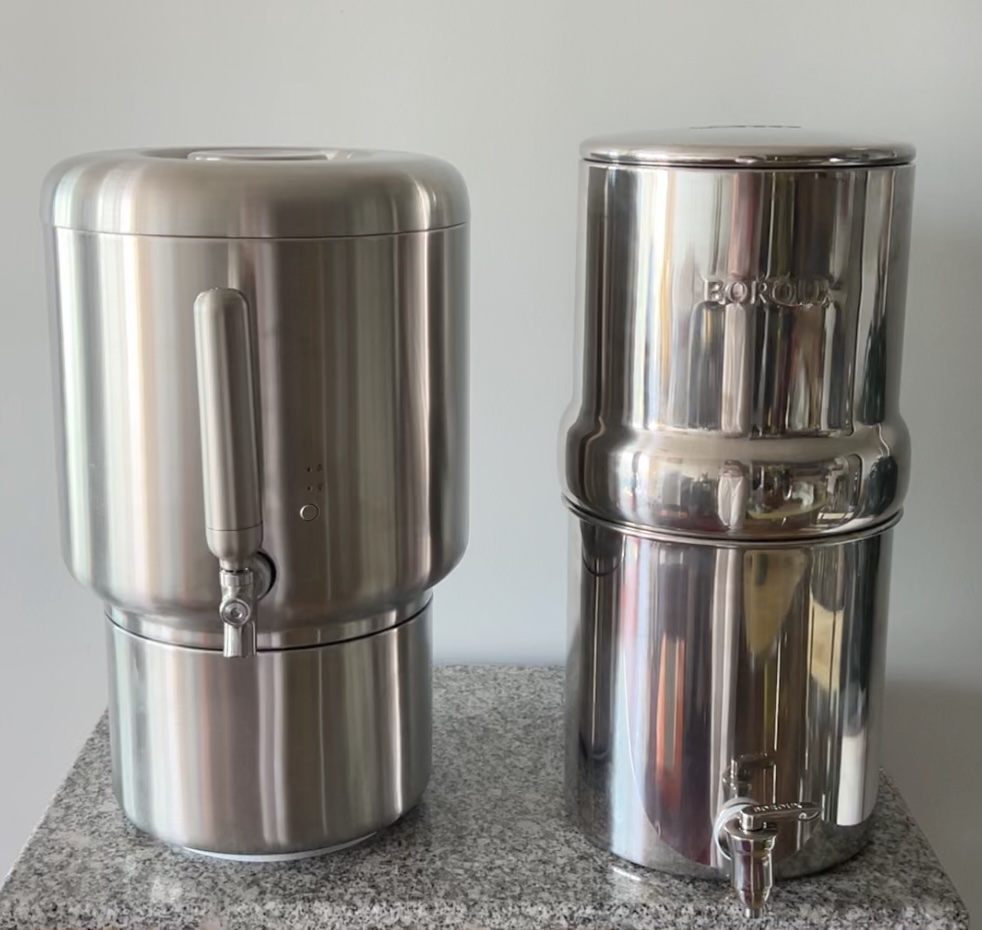
The 2.5 gallon medical-grade stainless steel system’s sleek design looks like an elevated kitchen appliance. It’s gravity-led, meaning no power necessary for filtration. It has a single proprietary Electrokinetic Nanofiber Filter inside that filters two gallons of water an hour.
Rorra has the easiest set up of the bunch — no priming the filter, no washers or wingnuts and no tiny loose parts to misplace during set up. It may only last 90 days like your typical fridge filter (or 200 gallons), the $75 (without subscription) replacement filter is the easiest of the bunch.
We like
We don't like


Waterdrop is essentially the Berkey dupe, but does it perform with the best of them? The main point of difference is price point, and it’s significantly less. The system is still NSF certified. It uses two activated carbon filters, and you can add their specialized filters to remove fluoride This may not be necessary in all locations as some cities have less fluoride than others. It’s designed to remove chlorine, sediment, heavy metals, PFAs and microplastics.
The 2.25 gallon system is made of food-grade stainless steel, and it comes with a stand to help glasses fit under spigot, allowing it to be away from the edge of the counter despite it being bulkier. The filters last up to 6,000 gallons between updates or 1,000 with the fluoride filter.
While you may pay less in your initial cost, the setup is more complicated on Waterdrop’s system. You’ll need a screwdriver and the liquid level indicator tube adds an extra step in the initial construction. This requires two replacement filters, but they’re about the same price as Rorra’s at $78.99, but they only need to be replaced every six to 12 months.
We like
We don't like

Another premium countertop system, Boroux also leverages NSF testing and certification as well as ANSI/CAN 372 (for lead-free compliance) and WQA Gold Seal certifications. What does this all mean? Up to 99.35% of heavy metals are filtered by the BOROUX Foundation Filters, including lead, mercury, cadmium, chromium, and uranium.
Boroux makes their systems of surgical-grade stainless steel, so they also have the sleek design, but they come in a variety of sizes which is a bonus for smaller households. There’s the compact filter system which is 1.8 gallons and meant for homes of 1-2 people and the Legacy version which is three gallons and meant for larger households. Stands are sold separately.
It requires two activated carbon filters and also produces two gallons of filtered water per hour. The initial assembly is less complicated than the Waterdrop’s but more than Rorra’s, but they come with a much heftier price at $160. However, the price is higher because the filters last a year.
We like
We don't like
In Conclusion
The most confusing parts of choosing a water filter are the vast amount of information and the claims put out by each manufacturer. The filtered water from each absolutely tastes and has a better mouth feel than the tap from my sink. While differences were subtle, I like Rorra the best. For me, the goal is to not have to think about the taste, scent or feeling of my daily drinking water, and the filters afford that. There are functional differences between them and aesthetic options to consider. Test your water, determine your needs, consider your counter space and budget — for both the system and the ongoing cost of filters — and make your purchase.