We like
We don't like
Our team is dedicated to finding and telling you more about the web’s best products. If you purchase through our links, we may receive a commission. Our editorial team is independent and only endorses products we believe in.
If I have a zit, I will touch it. I will pick and prod at it until it's a raging beast, opening up like a third eye on my forehead. I have zero self-control. Which is why the invention of pimple patches has been crucial for my wellbeing during an inevitable breakout — they're the only thing standing between me and my grubby little fingers.
They’re so essential now that it’s hard to fathom a time before their existence, but what we know and use today began as “hydrocolloid dressings” in the 1960s. They were used in medical settings to help protect and heal wounds. Fast forward to the 2010s in South Korea where they became a K-beauty staple before hitting the states — specialty stores in the U.S. would sometimes carry them, but you couldn't pop into a CVS or Target and grab a pack of pimple patches like you can today. In those fraught beforetimes, I had been known to purchase their not-so-distant cousin, hydrocolloid blister bandaids, and cut them into DIY pimple patches.
Now, you can find them almost anywhere with a skincare aisle. And though they’ve aesthetically evolved into cute shapes with multi-functional uses (brightening, soothing, etc,), the core technology really hasn’t changed much. Modern patches use the same hydrocolloid as their predecessors, which is a moisture-retentive dressing that pulls fluid out of a blemish, transforms it into a gel, and traps it beneath a waterproof, finger-proof barrier.
Since they came onto the scene, I've tried just about every shape, size, and formulation of pimple patches. I've worn ‘em day, night, through workouts, in the shower, and under makeup. And though any pimple patch is better than no pimple patch, I do have thoughts on what makes for a good one. Here’s my gold star criteria:

What I’m Looking For
Sweat resistance. So many patches fall right off the second you sweat through a workout or a warm night's sleep — which is why beveled edges matter more than people realize. They're the difference between a patch that clings for eight hours and one you find stuck to your pillowcase.
Disappearing under makeup. This is trickier than it sounds, because no matter how invisible a patch claims to be, there's always a faint circle underneath, and the smooth surface tends to send foundation sliding right off.
Accessibility. You can't predict when a pimple is going to show up. While I'd love to say I'm always stocked at home, the reality is I've made more than a few emergency drugstore runs mid-breakout — so how easy something is to get matters as much as how well it works.
Cost per wear. I'm factoring in not just price per package, but price per actual, usable patch — and a "variety of sizes" only counts if those sizes aren't mostly the tiny, useless ones. In my experience, the smallest size in most packs is basically decorative.
One notable omission is the famous star-shaped patch. It's objectively the cutest option on the market, but I've never once gotten it to stay put — the corners curl up almost immediately, and before I know it, I've got a gunk-filled star dangling off my chin in public. But damn, they’re really cute.
My Tried-and-Tested Favorites


This is your esthetician-approved patch. Yes it has a higher cost per patch and you’ll have to shop online, but you’re getting really good quality from an acne-focused brand in exchange. They’ve got beveled edges and are surprisingly low profile, and matte, so the invisible claim holds its ground. And really do stay put. I wore one on an international flight where I tossed and turned (I cannot sleep on a plane) and did a quick pre-landing refresh with a face wipe and some moisturizer and it stayed securely in place through it all.
Cost per patch: ~$0.42
We like
We don't like


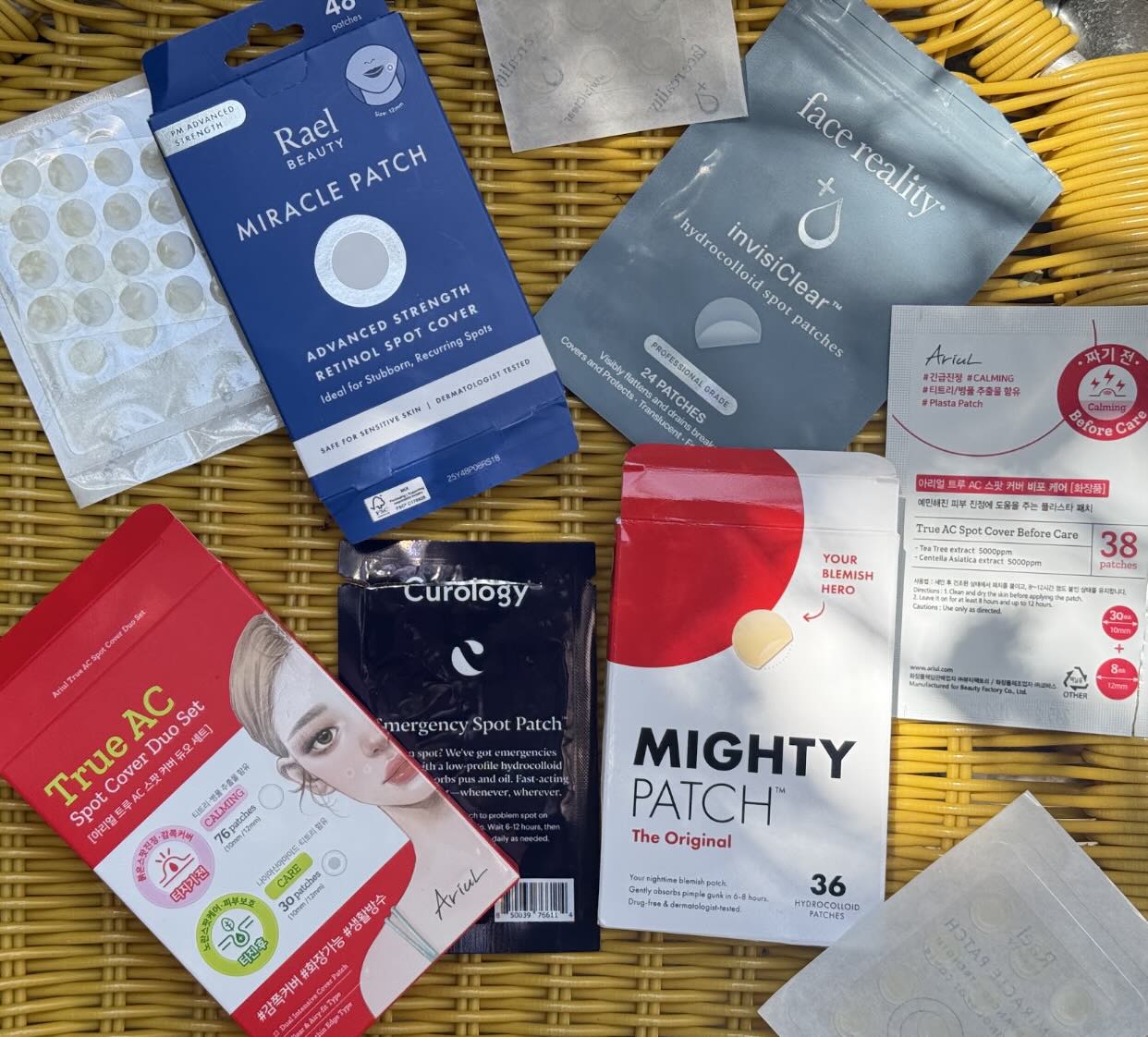
The accessible MVP. Hero Cosmetics was the first US brand to bring pimple patches to the masses and they’re still sitting at the top of the throne. I've grabbed this one in an actual zit emergency more times than I can count. They’re by far the most accessible — the boxes are sitting on a shelf at your nearest CVS or Target right now. While the edges aren't beveled and as secure as other options, it does its main job (draining the gunk) fabulously.
Cost per patch: ~$0.54
We like
We don't like

This might be the most slept-on brand in the pimple patch world and I will die on this hill. K-Beauty retailer Soko Glam’s blog-turned-brand The Klog has one of the most affordable options out there at $6 a pop. I’ve been known to buy five at a time (a whopping $30!) and stash them everywhere: my bag, my car, my desk. They’re great quality, too. They’ve got beveled edges that hold up on curves like your chin and jawline, and each pack has two actually useful sizes for your regular blemishes and more monster-sized blemishes.
Cost per patch: ~$0.14
We like
We don't like

I found these at Olive Young and was instantly sold on the two-step concept. Since hydrocolloid only works once a blemish has come to a head, this pack contains a “Before Care” option for early zit stages. It contains salicylic acid, tea tree extract, and calming centella asiatica to help foster a quicker pimple lifecycle. It’s also clutch to have protection for when you feel a zit forming and can't resist squeezing it into submission at a stoplight (guilty). Then, a classic hydrocolloid "After Care" patch takes over once it's ready to go and contains niacinamide to help reduce inflammation and redness.
Cost per patch: ~$0.15
We like
We don't like

A lot of "treatment" patches aren't actually hydrocolloid. They deliver ingredients to the area, but they don't treat an active blemish. This one does both. It’s a patch for the real bad boys — the stubborn, underground ones that haven't come to a head yet. It has a time-released retinol (retinyl palmitate, which is gentle on the skin) and pulls fluid out the way hydrocolloid always has. Plus, Rael’s clinical study shows significant improvement on deep breakouts in just 6 hours, which is pretty impressive. Because of the retinol, I’d save this one for nighttime, and make sure to wear SPF the next day.
Cost per patch: ~$0.31
We like
We don't like

Multiple blemishes crammed into one small area make patches tricky to apply — you end up overlapping edges or leaving gaps between them. This oversized and dermatologist developed version avoids that problem entirely by treating a wider area. It’s designed with contours for the areas where the skin tends to break out in clusters, like your forehead, chin, or chest. Sometimes it’s just grossly fascinating to see just how much gets sucked up into the bandage in a larger area.
Cost per patch: ~$1.15
We like
We don't like
Find What Works for You
This isn't an exhaustive list. There are plenty of patches out there doing the job well, and there are tons I haven't even tried yet. I'm only one human, and I'm also just trying to avoid breakouts like everyone else. But these are the best of the bunch, out of an embarrassingly large number of patches I've put through the wringer. Ultimately, you've got to find what works best for you. And if you need a starting point, I hope this points you in the right direction.